

In the life sciences industry, the term GxP represents the backbone of regulatory compliance and product quality. It is a general abbreviation for the “Good Practice” quality guidelines and regulations that are mandated by global health authorities like the U.S. Food and Drug Administration (FDA), the European Medicines Agency (EMA), and others. The purpose of GxP is to make sure that regulated products such as pharmaceuticals, medical devices, and biologics are consistently safe, effective, and suitable for their intended use. While many are familiar with specific terms like GMP (Good Manufacturing Practice), GxP is the overarching umbrella concept that covers a wide and interconnected range of activities throughout the entire product lifecycle. Achieving and maintaining GxP compliance is a prerequisite for any company wanting to bring a product to market. This guide will provide a comprehensive overview of GxP, its core principles, its relationship with GMP, and the function of a modern Quality Management System (QMS) and integrated Corrective and Preventive Action (CAPA) Software in ensuring sustainable GxP compliance.
Table of Contents
What is GxP Compliance and Why it Matters
GxP compliance refers to the mandated adherence to the set of regulations and quality guidelines that apply to a specific area within the life sciences. The “x” in GxP is a variable that can be replaced to denote a specific field, creating a family of acronyms such as Good Manufacturing Practice (GMP), Good Clinical Practice (GCP), Good Laboratory Practice (GLP), Good Documentation Practice (GDP), Good Storage Practice (GSP), and Good Automated Manufacturing Practice (GAMP). The overarching goal of these interconnected regulations is to build quality and safety into every step of the process. It is a proactive framework designed to prevent errors before they can happen.
GxP compliance matters profoundly because it is the primary mechanism for ensuring patient safety and building unbreakable trust with regulators, healthcare professionals, and consumers. An error in one GxP area can create a catastrophic chain of risk; for example, a documentation error in a pre-clinical lab study could lead to a flawed clinical trial design, which could result in an unsafe drug being manufactured and distributed, ultimately harming patients. GxP provides the framework of control and accountability to prevent such failures.
GxP in Pharma
In the pharmaceutical industry, GxP is the meticulously documented pathway from a molecule in a lab to a medicine for a patient. Every stage is governed by a specific set of GxP regulations that work in concert. The journey begins with initial research and pre-clinical safety studies in a laboratory environment, which must strictly adhere to Good Laboratory Practice (GLP) to ensure the scientific data is reliable, reproducible, and accurate enough to justify human testing. Once a compound is ready for human trials, operations shift to follow Good Clinical Practice (GCP), a complex set of ethical and scientific quality standards for designing, conducting, recording, and reporting trials that involve human subjects. The primary goals of GCP are to protect the rights and safety of participants and to ensure the resulting clinical data is credible. Following successful trials, the commercial manufacturing of the approved drug product is governed by Good Manufacturing Practice (GMP), where the principles of CAPA in Pharmaceuticals are vital for addressing any production issues.
GxP in Healthcare
In the broader healthcare ecosystem, GxP principles extend far beyond the manufacturing plant to protect product integrity throughout the complex global supply chain. This is where Good Distribution Practice (GDP) and Good Storage Practice (GSP) become critical. These regulations govern the vast network of logistics involved in moving products from the manufacturer to the end user. They include stringent controls for temperature and humidity monitoring (especially for “cold chain” products like vaccines and biologics), preventing contamination, ensuring proper stock rotation, and providing security to prevent counterfeit medicines from entering the legitimate supply chain. GxP compliance in this context guarantees the integrity of the whole system, safeguarding products until the moment they are dispensed or administered to a patient. For device companies, the effective management of CAPA in Medical Device manufacturing is equally crucial to this integrity.
GxP vs GMP
It is common for there to be confusion between the terms GxP vs GMP, but the distinction is straightforward and crucial for understanding the regulatory landscape. The easiest way to understand the difference is that GMP is a specific and vital subset of the broader GxP framework.
GMP, or Good Manufacturing Practice, refers specifically to the regulations and guidelines that govern the active manufacturing of products. It is concerned with what happens within the four walls of the production facility and its associated quality control labs. It covers tangible aspects like facility design and environmental controls, equipment qualification and calibration, process validation, personnel hygiene and training, and the creation of detailed batch records that provide a full history of how a product was made.
GxP, on the other hand, is the all-encompassing term that includes GMP as well as all other “Good Practice” regulations that apply throughout the product lifecycle. This includes the GLP work done by contract research organisations, the GCP work done at clinical trial sites, and the GDP work done by third-party logistics partners. The distinction in the GxP vs GMP debate is one of scope: GMP is focused on the production process, while GxP covers the entire ecosystem that supports that process.
ALCOA+ Principles
A core concept that underpins all GxP activities and documentation is the principle of data integrity. In a regulated environment, the operational mantra is: “If it wasn’t documented, it didn’t happen.” The ALCOA+ framework provides the globally recognised set of criteria for ensuring that all data and records, whether on paper or electronic, are trustworthy and reliable.
- Attributable: It should be clear who performed an action and when. This ensures accountability and traceability for every piece of data created.
- Legible: Data must be readable and permanent throughout the data lifecycle. If a record cannot be read, it is worthless as evidence.
- Contemporaneous: Data should be recorded at the time the work is performed. This prevents back-dating or recording from memory, which introduces errors and inaccuracies.
- Original: The record should be the original source or a certified true copy. This ensures the data has not been altered or transcribed incorrectly from another source.
- Accurate: The data must be correct, truthful, and free from errors. The validity of all conclusions depends on the accuracy of the underlying data.
- Complete: All data, including any repeat or reanalysis performed, must be complete. Withholding or losing data, even if it is an out-of-spec result, is a major compliance violation.
- Consistent: Data should be presented in a consistent format and a chronological sequence. This makes data easier to review and understand and highlights any unexpected deviations.
- Enduring: Records must be maintained and protected in a durable format for their entire retention period. Data must be retrievable for years after a product is made for audits or investigations.
- Available: Records must be readily accessible for review or audit by authorised personnel. Data that cannot be found upon request is equivalent to non-existent data in the eyes of an auditor.
Together, these principles form the foundation of trustworthy data, which is essential for demonstrating compliance and ensuring patient safety.
QMS Role In GxP
A Quality Management System (QMS) is the primary vehicle for achieving and maintaining GxP compliance. It is the formalised business system that translates the complex requirements of GxP regulations into practical, day-to-day operational activities and controls. A robust QMS provides the necessary policies, procedures, and resources to ensure that QMS Standards are systematically met across the organisation. Key modules within a QMS directly enforce GxP principles: Document Control manages the lifecycle of SOPs that define GxP tasks; Training Management ensures personnel are qualified and competent; Change Control provides a structured process for managing modifications to validated systems; and a robust CAPA module ensures Non-Conformances & Deviations are thoroughly investigated and resolved. An electronic QMS (eQMS) is particularly valuable in a modern GxP environment. It acts as a digital nervous system, automating critical processes, enforcing compliant workflows, and providing a centralized, secure repository for all electronic records. A well-designed eQMS automatically creates indelible audit trails that satisfy ALCOA+ principles and meet the technical requirements of FDA 21 CFR Part 11, making it much easier to demonstrate a state of control and compliance to auditors.
GxP Compliance Best Practices
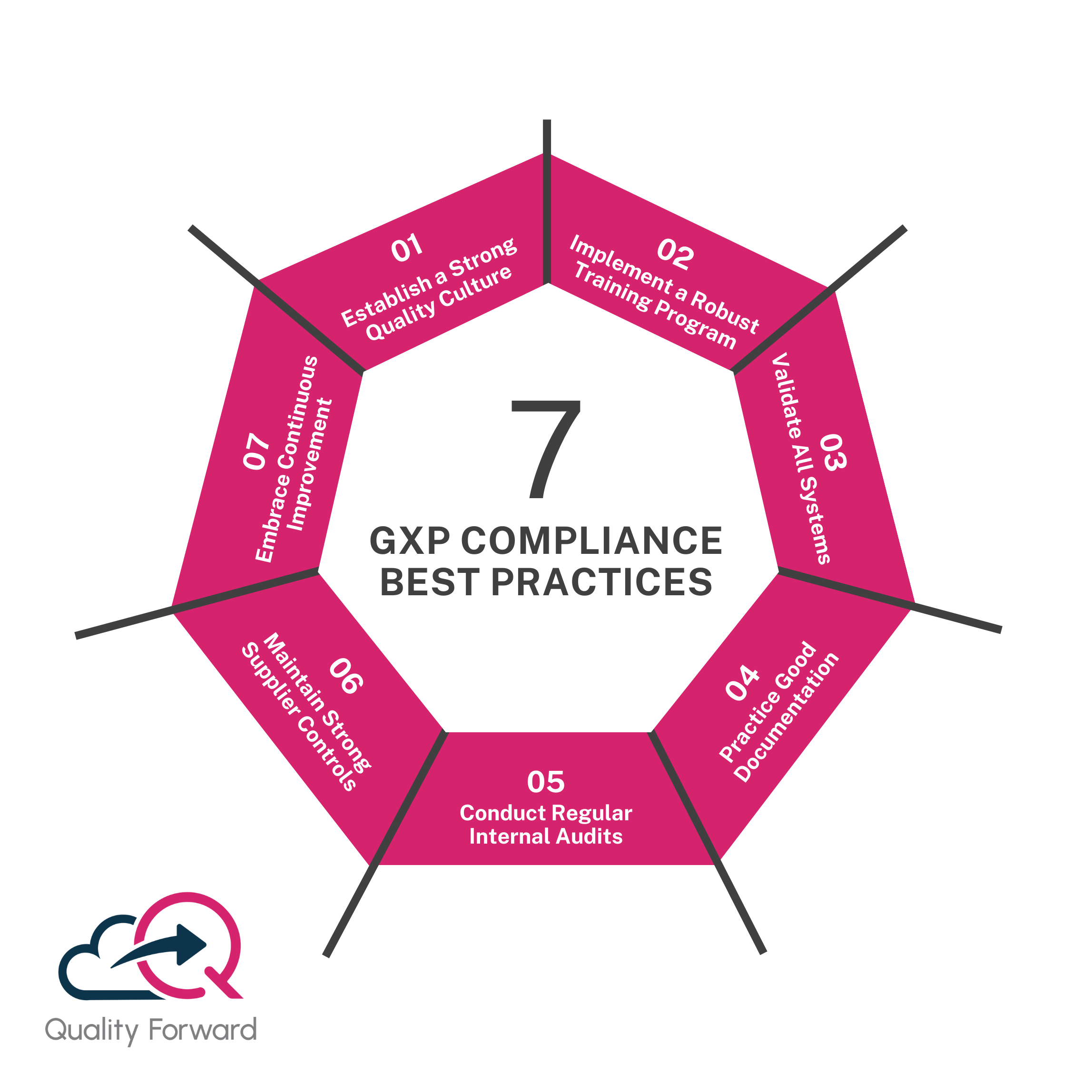
Adhering to a set of best practices is essential for building a sustainable culture of GxP compliance. These practices move an organisation from a reactive “check-the-box” mentality to a proactive, quality-focused state of being.
- Establish a Strong Quality Culture: Compliance must start at the top. Senior management must demonstrate a clear, consistent, and visible commitment to quality, not just as a departmental function but as a core business value. This means providing the necessary resources and empowering every employee to take ownership of quality in their role.
- Implement a Robust Training Program: All employees must be thoroughly trained on the GxP principles that apply to their specific roles before they begin their duties. This training should be role-based, ongoing, and include periodic effectiveness checks to ensure the knowledge is retained. All training activities must be meticulously documented within the QMS.
- Validate All Systems: Any computer system used to create, modify, or store GxP data must be formally validated. This process, known as Computer System Validation (CSV), provides documented evidence that the system operates exactly as intended in a reliable and reproducible manner, ensuring it maintains data integrity. This is especially true for any CAPA Software.
- Practice Good Documentation: Live by the mantra “if it wasn’t documented, it didn’t happen.” All activities must be documented accurately and contemporaneously, following the ALCOA+ principles. Documentation should be clear, concise, and error-free to provide a reliable history of all GxP activities.
- Conduct Regular Internal Audits: An internal audit program is a critical self-assessment tool. Proactively conduct these audits to assess the health of your QMS and identify any potential compliance gaps before they are found by an external regulator. This allows for self-correction and continuous improvement.
- Maintain Strong Supplier Controls: Your critical suppliers and vendors are viewed by regulators as an extension of your own operations. You must have a robust system for qualifying, auditing, and monitoring your critical suppliers to ensure they also meet GxP standards and do not introduce risk into your product.
- Embrace Continuous Improvement: Use the data from your QMS, such as audit findings and CAPAs, to drive meaningful, data-driven continuous improvement in your processes and systems. This aligns with modern regulatory expectations, such as those found in the ICH Q10 Pharmaceutical Quality System guidance.
By implementing these best practices, an organization moves beyond simply meeting regulations to embodying a true culture of quality and continuous improvement.
How to Choose the Right QMS
Choosing the right QMS is one of the most important strategic decisions a life sciences company can make to ensure GxP compliance. The system must be specifically designed and purpose-built to meet the stringent requirements of the industry, not a generic business software adapted for the purpose. When evaluating options, look for a QMS for Pharmaceuticals that has built-in, out-of-the-box CAPA software for FDA compliance. The software architecture should support all key quality standards, including the principles of the ICH Q10 Pharmaceutical Quality System. The CAPA Definition within the software should be flexible enough to meet various regulatory needs.
Critically, a system that provides a pre-validated framework can significantly reduce your internal validation burden. This means the vendor has already executed much of the foundational Installation Qualification (IQ) and Operational Qualification (OQ), saving your team hundreds of hours of work and cost. This allows you to focus your resources on validating your specific configurations and user processes. A modern Corrective and Preventive Action (CAPA) Software is not just a tool, but a central pillar of this strategy. To achieve this, organisations should consider an integrated platform like Quality Forward, which provides a comprehensive, compliant, and user-friendly CAPA Software solution designed to manage all aspects of GxP, serving as the single source of truth for your entire quality operation. This type of CAPA software for FDA compliance is essential for any regulated company.
Frequently Asked Questions (FAQs): GxP Compliance
GxP compliance refers to the set of “Good Practice” quality guidelines, such as Good Manufacturing Practice (GMP), Good Clinical Practice (GCP), and Good Laboratory Practice (GLP) that ensure regulated products are safe, consistent, and reliable. These standards are required by agencies such as the U.S. Food and Drug Administration (FDA).
GMP is one part of the broader GxP framework, focused specifically on manufacturing processes. GxP encompasses GMP, GCP, GLP, and other disciplines across the product lifecycle, from research to post-market control. Learn more about GMP principles from the World Health Organization (WHO).
Pharmaceutical, biotechnology, medical device, clinical research, and contract manufacturing organizations are all subject to GxP requirements. Compliance ensures traceability, data integrity, and patient safety throughout product development and supply chains.
The core elements include clear documentation, validated systems, traceable data, trained personnel, and secure recordkeeping. Each process must demonstrate adherence to the ALCOA+ data integrity principles – that data be Attributable, Legible, Contemporaneous, Original, and Accurate.
An eQMS centralizes audits, CAPAs, training, and document control in one system, ensuring that records are audit-ready and easily traceable. It helps organizations maintain ongoing compliance with GxP and regulatory standards such as 21 CFR Part 11.
Non-compliance can result in warning letters, import alerts, product recalls, or loss of manufacturing licenses. Regulatory agencies such as the European Medicines Agency (EMA) routinely publish inspection findings and enforcement actions for reference.
The applicable “x” in GxP depends on the organization’s activities, GCP for clinical trials, GLP for laboratory testing, GMP for manufacturing, GDP for distribution, etc. Each must align with the quality expectations defined by regulators and industry standards.
Maintain a documented QMS, perform periodic internal audits, validate computerized systems, train personnel regularly, and assess suppliers for compliance. Continuous improvement and management review are essential for maintaining a compliant quality culture.